
Red Star Over Gatlin
Updated: Sep 13

In His Image
Every young reader finds in The Chronicles of Narnia a series of precise allegorical depictions of Christian mythology. The lion Aslan as God-the-Son; the Emperor-Over-the-Sea as God-the-Father; Edmund Pevensie as Judas; Turkish Delight as temptation, even though it tastes terrible.
But the author did not agree with his young readers. C.S. Lewis took issue with the specific word allegory being applied to his works. He mused on this question of category at length in his personal letters to friends, eventually landing on the word supposal,
Allegory and such supposals differ because they mix the real and the unreal in different ways. Bunyan’s picture of Giant Despair does not start from supposal at all. It is not a supposition but a fact that despair can capture and imprison a human soul. What is unreal (fictional) is the giant, the castle, and the dungeon.
Lewis is dead now and that’s a pity for me. I could really use his help with something.

It Is Remade
Stephen King’s short story Children of the Corn was first published in 1977 and adapted for cinema in 1984.
George Goldsmith, the film’s screenwriter, described the film as a metaphor for the Iranian Revolution. Most film critics did not pick up on this comparison at the time, which is completely understandable.
After all, drawing parallels between the plot of a campy 80’s splatter film and foreign politics is obviously ridiculous.
Right Turn Wrong
Children of the Corn tells the story of an unhappy married couple–Burt and Vicky–whose cross-country road trip to California is ruined after they make an unplanned stopover in Gatlin (“Nicest little town in Nebraska”, population 5,431) after taking a wrong exit.
The town held many trappings of a midcentury rural outpost in the American Heartland: a police station, a diner, a post office, a church. Certain other mainstays of rural life were absent: the elderly couple on porch rocking chairs, a middle aged fire-brand preacher, twenty-something waitresses and Vietnam Veterans.
Over the course of King’s short story, Burt and Vicky uncover the frightening underbelly of small town life. Prior to the events of the story, the children of Gatlin had been overcome with intense religious fervor and violently overthrown the existing establishment. In its place they installed a tyrannical theocracy overseen by fire-brand prepubescent prophets in service of a cruel new God.
Left Turn Wrong
In the Summer of 1966, studio execs in Beijing greenlit production for a documentary splatter porn called The Great Proletarian Cultural Revolution. Everyone in the People’s Republic of China (“Workers’ Paradise”, population 750 million) was invited to respond to an open casting call for extras. They all got the part, especially the ones who never auditioned.
The epic production was released with great enthusiasm from young viewers. When free tickets for a premier event in Tiananmen Square were offered to students, millions turned up for a sold out show. These young super fans, who made the Cultural Revolution their entire personality, were called the Red Guards.
There was trouble on set from the beginning. Working conditions were not particularly safe for any of the cast or crew. When production wound down in 1976–upon the death of its director, writer, lead actor, and executive producer, a twisted auteur called Great Helmsman–somewhere between 500,000 and 2 million extras had died on set.
This was horror with Chinese characteristics.
Watercolor on Silk
Xiao Ye and her four siblings knelt together on the living room floor of a house in Shanghai. The fervor of the Cultural Revolution had recently entered their young hearts and minds and they prepared to do what would have been unthinkable just months earlier.
Before the kneeling children were laid five antique paintings of the Ming Dynasty: four portrait landscapes—one representing each of the four seasons— and a centerpiece depicting three fierce tigers. Watercolor on silk, framed in rosewood. One for each child.
The paintings had hung in a capitalist home and they had to go. Xiao Ye chose Winter because it was her least favorite season. With scissors in hand, she set to her task commanded by Great Helmsman and tore the painting to pieces.
Crayon on Paper
Sarah sat criss-cross apple sauce on her bedroom floor doing what she had been commanded not to do.
Vicky held up the child’s drawing. Depicted were two knife-wielding male figures dragging a bloodied woman between them through a cornfield.
“What is this?” Vicky asked the girl, frightened.
“You” replied Sarah, giggling.
Child Star Leads
Child actors feature prominently in both the Cultural Revolution and Children of the Corn. The preference for youth was baked into both scripts.
Immediately after the premiere in Tiananmen Square, marauding gangs of students rampaged across Beijing. They attacked barbers, tailors, photographers, book sellers and other professionals deemed to be in service of the Bourgeois class.
From the outset, the foot soldiers of Great Helmsman were kids. The same was true in Gatlin.
Gang of Two
The God of Gatlin, called He Who Walks Behind the Rows, could not act on His own. He needed competent bureaucrats to run the cult. In the story, readers meet two young lieutenants who manage the town’s sordid affairs.
Isaac was young, clever, and behatted. It was to Isaac that the demon God first appeared in the cornfield to share in His prophecy of death. He served as the cult’s High Priest.
Malachi was elder and ginger and had a talent for violence. He served as the cult’s Torturer-in-Chief.
Adult Film Stars
Many of contemporary China’s A-list performers are connected with the Cultural Revolution.
Xi Jinping is a good example. His casting can be attributed to reverse nepotism. His father was fired on set and then rehired multiple times throughout the production. As a result, Xi was cast as an errand boy who was sent to the countryside to gather stage props.
Deng Xiaoping and Zhou Enlai are two other examples, but they are remembered more for their talents in the craft of state than stage. More on them later.
Officially, the Cultural Revolution had four appointed showrunners.
Gang of Four
Great Helmsman was all about theater but He could not act alone. He, too, needed assistance and had four main lieutenants: Jiang Qing, Zhang Chunqiao, Yao Wenyuan, and Wang Hongwen.
Only Jiang Qing was particularly interesting. Her job was to conduct performance reviews and to ensure the other cast members stuck to the script. No improvisation was allowed on set, under penalty of exile or death. As a former actress herself, she was well-suited to the task.
She also did for her auteur what the other three could not, on their life. She married Him and became His fourth wife.

Dangerous Liaisons
Jiang Qing had been a stage actress on the Shanghai theater circuit. Her most notable acting gig came in 1935 when she played Nora Helmer in Ibsen’s A Doll’s House. This was the first indication that she would become more ‘brutal tyraness’ and less ‘demure housewife’ later in life.
Jiang Qing lasted longer than the members of Great Helmsman’s first wives club and shared fewer laughs.
His first wife, Luo Yixiu, barely made it past what the Gatlinites called the age of favor. She died of dysentery at aged 20 while living with her in-laws after He left her to pursue His studies. Wife number two, Yang Kaihui, was executed at age 29. Wife number three, He Zizhen, was exiled to the Soviet Union and forcibly committed to a psychiatric institution.
King never defines the penalty for gay marriage in Gatlin, let alone proposing gay marriage to He Who Walks Behind the Rows. But readers can assume that such a proposal would incur, at minimum, crucifixion at the hands of children. Whatever the penalty, it is safe to say that heterosexual marriage to Great Helmsman in China was only a slightly less precarious undertaking.
Ask and Tell
Early in the ‘84 film adaptation, Burt and Vicky stop for gas and ask for directions.
Old Man Diehl, the town’s mechanic, refuses to sell them any gasoline.
He urges them onward; due West and away from Gatlin.
A Violent Song
The day before violence erupted onto the streets of Beijing, Great Helmsman had made a public appearance to promote his artistic vision. He was accompanied by a young woman named Song Bin-bin.
“Do you want violence?”, He asked the girl.
Her response was unambiguous but did involve mincing words. She announced that she was changing her name on the spot. She was now Song Yao-wu.
Song Wants Violence.
A Loyal Zhong
The day after the Ye children destroyed the antique paintings, seven Red Guards—aged teen to early twenties—paid them a visit.
Xiao Ye’s brother was steadfast. He took the opportunity to demonstrate his devotion to Great Helmsman and announced that he, too, was changing his name on the spot–to Zhong.
Loyalty.
Just to Rebel
The Red Guards and the Gatlin theocrats achieved early victories in obviously similar ways: rural peasants and the young–egged on by leaders who glorified violence–won quick battlefield victories using guerrilla tactics.
What’s more interesting and less obvious are the events that transpired just prior to the outbreaks of violence; the social conditions in place beforehand that served as springboards into chaos and despotism.
Luckily, both Stephen King and Historians of the Middle Kingdom offer clues that might explain what happened. The clues point to the same culprit.
Taketh and Eateth
As the couple wander around the empty town, taking note of the unsettling surroundings, Burt develops a theory for why the children took over,
“Why? The corn. Maybe it was dying. Maybe they got the idea somehow that it was dying because there was too much sinning. Not enough sacrifice.”
We don’t need to take Burt’s word for it. In the short story, the author offers an italicized aside that cannot be directly attributed to Burt’s thoughts. Here we are hearing from Stephen King himself,
“Dear God we beg thy blessing on the crop. For Jesus’ sake, Amen.”
Ground Maybe Fertile
Between 1958 and 1962, China was plagued by crop failures. This period is called The Great Chinese Famine.
Famines create unrest, and unrest can provide the necessary conditions for revolution—especially under the helm of clever propagandists.
The famine was deadliest in China’s central provinces–its middle Heartland. Somewhere between 10 and 50 million people starved to death.
Blame on Him
Readers of Children of the Corn can’t know for sure what caused the crop failures in Nebraska–they occurred just prior to the Gatlin Revolution, possibly between 1958 and 1962.
In the ‘84 film, He Who Walks Behind the Rows does more burrowing than walking. His subterranean physical embodiment is never seen, but He moves beneath the soil, leaving dirt mounds in His wake. It’s not difficult to imagine how such movements might have displaced the corn’s root structure, leading to a reduced harvest.
Whatever the cause, it was the pre-Revolutionary establishment in Gatlin that took the blame.
Blame on Who
Blame for The Great Chinese Famine can be at least partially attributed to Great Helmsman. In 1958, He had secured permission for His first epic disaster, The Great Leap Forward, which was a plan to modernize China’s economy to catch up with the industrial West.
That failed plan involved the gross misappropriation of resources and labor, which combined with unlucky weather resulted in disaster for the agricultural sector.
Whatever the cause, it was the pre-Revolutionary establishment in China that took the blame.
Blame on Jew
The Great Leap Forward underperformed financially and underwhelmed audiences. How did someone like Great Helmsman stick around long enough to secure resources for another money-losing, culturally ruinous venture despite obviously bad writing and gross over-budgeting?
This may seem unfathomable to Americans, but it needn’t be.
Our own studio execs in Hollywood now adhere to this practice as orthodoxy and everyone seems to just say ‘that’s fine’.

Bear Eye Shadow
By the early 1960s, Great Helmsman believed the fire of the Chinese Communist revolution had begun to fade. He believed salvation could only be found in further struggle against class enemies. But His narrative was also influenced by events happening further North.
At around the same time, the Soviet Union was reforming and the Russians were flirting with the Americans. Great Helmsman believed this was antithetical to the One True Word of Communism and He did not wish to import bourgeois revisionism into China.
He also detected in the Kremlin’s repudiation of Stalinist absolutism a future threat to His own cult of personality. Thus the Cultural Revolution was as much about securing His own leadership as anything else. It was local politics.
But it was also more than that. What formally began in China as a revolution in politics (disguised as culture) also reached the realm of the spiritual.
Not Grace Baptist
In the ‘84 film, Burt is seen venturing down Main Street in Gatlin. He sees a church, walks in, and approaches the pulpit. On the lectern he finds a Bible opened to the Book of Job. The words of King James have been heavily annotated and the New Testament has been scribbled out.
Beneath the Bible he finds a book of records detailing the names and birthdates of parishioners of what is clearly no longer the Grace Baptist Church of Gatlin.
Most of the names have been altered. Secular Richard, George, and Roberta have been changed to Amos, Zepeniah, and Mary.
I Was Reborn
Among the student pilgrims who traveled to Beijing to bear witness to Great Helmsman’s premiere was a man whose name is neither here nor there.
That’s fine, he probably changed it then and there.
“Today, I saw Him for the first time”, he wrote. “I have changed my life to make today my birthday.”
Xiao Ye was there, too. But she blinked and missed the motorcade. When she got back to Shanghai, she lied and told her siblings she had seen God.
Was I Reborn
Amos stood in front of the congregation on the last day of his life. He had no shirt but he had a knife.
“Today is my birthday”, he told the children. “The first night of my 19th year. As it is written, I shall not die but pass to Him.”
He carved a pentacle into his chest and filled a chalice with blood. The children dranketh.
Just About God
Stephen King never provides a fully fleshed out theology for the agrarian cult depicted in Children of the Corn. He describes the children of Gatlin wearing Amish-style clothing, but the absence of spoken Pennsylvania Dutch limits the viability of this comparison.
But through their adherence to plain dress and disinterest in secular politics, the Gatlines do share a quality with the Amish. Travel to the Amish enclaves of Baptist country and you won’t find many stars or stripes.
The Amish aren’t about God and Country. They’re just about God.
All About God
Despite lacking a detailed description of the Gatlin creed, discerning readers will find the Gatlin cult’s ontology is clearly a derivative of Christianity, but one that has strayed far from Christ.
We can find similarities between the Gatlin church and two other non-Trinitarian Christian offshoots.
Both are from the 19th century; one American and one Chinese.
Also in Nebraska
Look slightly to the left of Gatlin and find The Church of Jesus Christ of Latter-day Saints. This spiritual proximity can be measured in three observations.
First, both are uniquely indigenous to the United States–the prophets and early followers of each faith were all American Citizens. In 1847, Mormon pioneers had even established a winter encampment in Nebraska on their way to the promised land of Utah.
Second, church leaders of both share an affinity for wide-brimmed hats and maintaining detailed genealogical records on its members.
Third, the Bible is central to each but room is made for adaptations to the canonical scripture.
Also in China
To the right of Gatlin and further East than Rome, we find The Heavenly Kingdom of Great Peace.
Three years after the Mormons left Nebraska, a man from Guangzhou called Hong Xiuquan grabbed the mic and announced that he was the younger brother of Jesus Christ. His followers sought the overthrow of the Qing Dynasty and launched the Taiping Rebellion.
25 million people perished in the ensuing violence and famine.
On This Day
In the film, viewers learn that just prior to the outbreak of violence in Gatlin, Isaac had gathered (almost) all of the town’s children into a cornfield to share a prophecy revealed unto him by He Who Walks Behind the Rows.
Within minutes of hearing His Word, the town’s children enter Hansen’s cafe. Blood was not on the menu, but the children were hungry. All of the adults were immediately murdered.
One unlucky patron ended breakfast with his hand shoved in a meat grinder.
This Day On
A search for spiritual origins of the Cultural Revolution leads not to prophecy and revelation, but to scripture and baptism.
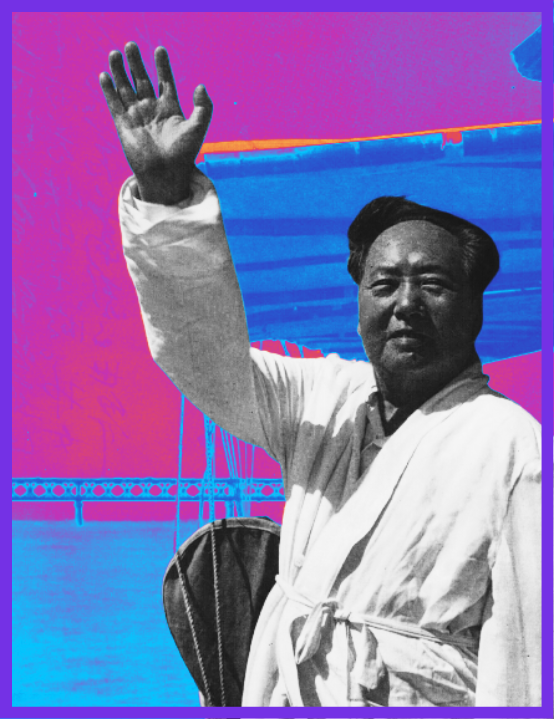
Two months before the premiere rally in Beijing, Great Helmsman gathered photographers from across China to Hubei Province to bear witness as He went for a ritual dip in the Yangtze Mikveh. He even brought a kittel.
We will return to His One True Word later on.
Girlboss Lean In
In China, men still run the politics. But in other fields, like in higher education attainment, there is roughly gender parity between the sexes. The advancement of women in China may have origins in the Cultural Revolution–Great Helmsman was keen on women in the workplace.
In the Children of the Corn film, a young Priestess is seen overseeing the ritual passing of Amos. When Burt enters the church, she commands a young parishioner to fetch Malachi to deal with the intrusion. But she doesn’t wait for him. When Burt interrupts the Eucharist, she stabs him.
Here both China and the Gatlin cult are well to the left of the Mormons and the Amish, both of which forbid women from top leadership positions and from administering the Eucharist.
Child Safe Lock
From all around the Children were coming. Some of them were laughing gaily. They held knives, hatches, pipes, rocks, hammers. One girl, maybe eight years old, with beautiful long blond hair, held a jackhandle. Rural weapons. Not a gun among them.
Depicting a schoolyard posse of Nebraska preteens incapable of obtaining a single firearm inside 60 seconds is perhaps the most unrealistic plot point of the entire Children of the Corn media franchise.
But from this detail, a deeper point emerges: that what began in Gatlin as politics (disguised as religion) altered the community’s material culture.
Lock Safe Child
Luckily for the children of Gatlin, conflict never broke out between them and the children of China.
The Americans would have been severely outmanned.
In 1967, Red Guards stormed a PLA weapons depot and were seen operating battle tanks on the streets of Chongqing.
Out with Old
The day before Song decided she wanted violence, banners had appeared across Beijing declaring war on the past. Great Helmsman believed that China’s struggling advance was being hamstrung by what He called the Four Olds.
“We want to take and smash all old ideas, old culture, old customs, and old habits” one poster read.
In addition to class enemies, the material culture of China’s ancient past (Ming Dynasty paintings, Confucian scrolls that had guided their civilization for 2,500 years) were targeted and destroyed.
Out with New
In Gatlin, there is only one clearly defined old – age. Anyone over the age of favor–eighteen–was to be killed.
But the Gatlinites enforce other prohibitions, too.
In the film, turntables are considered contraband. The punishment for radio jamming may or may not involve crucifixion.
Out with Outlander
During the Cultural Revolution, Western culture was prohibited in China. The same day Red Guards attacked the four olds, they also came for high-heeled shoes and English flower gardens. Eventually, when relations between the Soviet Union and China came to the brink of war, Russian culture was also cancelled.
In Gatlin, Burt and Vicky aren’t actually accused of being too old, even though both are a few years over the age of favor. Their crime is their mere presence as foreigners. The couple are derided as outlanders by the children and put on trial for being who they are.
Where China banned the past, Gatlin banned the present. What they shared was a prohibition on all-things foreign.
Tariffs paid in blood.
Climb to Heaven
Granny Ningbo had sewn red silk burial shoes for herself.
She was made to walk down the lane in her funeral outfit, followed by jeering children, and was forced to throw the garments into a bonfire. She died not long after.
Granny Ningbo had stitched a ladder to each sole to help her climb to Heaven.
No to King
Like the Jews, the Chinese prepare for death.
Making funeral arrangements ahead of time was customary in China. The practice was believed to bring good fortune in the afterlife. But Great Helmsman disliked this tradition and forbade it. His Red Guards went further.
Emperor Wanli–who ruled when the Ming paintings were painted–prepared for his burial. But his skeleton did not lie in the chamber forever.
After a peaceful rest of 350 years, Red Guards raided the Royal Ming Tombs and burned the old king’s bones.
Death Becomes Him
The former leader of Gatlin–a police captain the children called Blue Man–did not prepare for his burial and it would have been a waste of time if he had.
His skeletal remains were left on display in the cornfields, subject to daily ridicule by the children of Gatlin. Crucified and died, but not buried.
The former leader of China–Liu Shaoqi–was once considered a shoe-in for directing any unhinged sequels to the Cultural Revolution. But the tides turned and he was purged. He had a room of his own, but it had no view.
He died in a basement prison cell in 1969.

Death Becomes Her
In the short story, Vicky’s eyes are gouged out and her sockets stuffed with cornsilk. In the film, she is treated more gently by the children. She is mounted on a cross and paraded through the corn while the children point and shout, “Kill! Kill! Kill!”
Wang Guangmei was the wife of Liu Shaoqi and had been a contender for Best Supporting Actress in the Cultural Revolution. But her bitter rival—Jiang Qing—went full Tonya Harding and had her hopes kneecapped by Red Guards.
Wang Guangmei’s ritual denunciation, officially called a ‘struggle session’, involved standing on a podium with her arms outstretched for hours on end, while children screamed at her. This was a common punishment for nonbelievers during the Cultural Revolution.
It was called airplane position and it meets the legal definition of torture.

Smile Brave Brother
Xiao Ye smiled, remembering her brother’s brilliance.
His spontaneous name change had fooled their young interrogators.
The Red Guards left the children alone that night.
Kill Thy Darlings
In both China and Gatlin, infighting and betrayal was common among the prophet-enforcers. The bureaucrats had forgotten a cardinal rule of life under tyranny. As Great Helmsman was fond of saying, “Good things can become bad things and vice versa”. He was right. What can be giveth can also be taketh.
As the story progresses in Gatlin, a growing political rivalry between Isaac and Malachi (disguised as a difference in the interpretation of doctrine) threatens the community with schism.
Malachi claims that Isaac has strayed from the One True Word of He Who Walks Behind the Rows. The two denounce each other as heretics and try to persuade the child mob to murder the other.
In China, political rivalries between the lieutenants (also disguised as differences in the interpretation of doctrine) were common. They kicked into high gear after Great Helmsman died and His box office failure was laid bare.
When Jiang Qing won Best Supporting Actress for her role in the Cultural Revolution, no one dared to raise the possibility of nepotism or rigged voting. But after her husband’s death, her Golden Globe was seized. Jiang Qing was denounced as a white-boned demon by the other members of the Gang of Four. Her death sentence was later commuted to life imprisonment and she was released for medical treatment.
She killed herself in 1991.
Grace to Come
Look through the chaos and butchery in China and Nebraska and you will find true believers–people who kept the ship sailing despite very rough seas.
Zhou Enlai was one of the adult film stars of the Cultural Revolution, but he was also a great statesman. He had served as China’s Foreign Minister and helped facilitate Nixon’s visit to China in 1972. His daughter, Sun Weishi, was another contender for Best Supporting Actress. And like her rival, she had a career in the arts. Sun Weishi is credited as the first female Director for a spoken word artform native to China called Huaju. Jiang Qing had her tortured to death by Red Guards.
Despite the family tragedy, Zhou Enlai remained loyal to China and kept managing state affairs–through all the chaos, right until the end. He died in 1976, just before the final act.
Deng Xiaoping was another prominent adult film star of the age, and an even better bureaucrat. The Red Guards threw his son out a window, paralyzing him for life.
But Deng Xiaoping remained loyal to China and kept working. He made reforms to China’s economy in 1978. From then on, everything else was made in China, too.
In Gatlin, the role of dedicated-until-the-end civil servant is found in the young priestess who administers the more-Catholic-than-Protestant Eucharist.
Late in the film, Burt throws a molotov cocktail (the role of gasoline is played by water) into the cornfield and the Gatlin cult’s collapse seems imminent. But the priestess was a patriot and didn’t give up on her community.
She hides in the backseat of Burt and Vickey’s ‘62 Thunderbird, concealing a scythe. Her ambush is thwarted when Burt slams the car door in her face, knocking her out cold.
Courage and Bravery
After Xiao Ye and her siblings destroyed the paintings, the children were distraught. They hadn’t cried like that since their mother died. The paintings had been their parent’s pride and joy.
Earlier, when her younger sister, oversized-scissors in hand, began shredding Summer, Xiao Ye burst into tears and tried to stop her.
The paintings represented both capitalist excess (their father had been a successful factory owner) and old culture, and the children knew they were in danger if the artwork was discovered in their possession.
The children acted because they had to; they knew the Red Guards were coming. Someone had tipped them off.
Brave Old Man
Old Man Diehl was the only person in town over the age of favor allowed to live. He was spared because he had access to fuel that the Gatlin theocrats needed to operate their unhinged society.
Old Man Diehl’s attempt to save the married couple—by urging them to avoid Gatlin altogether—failed but he didn’t live long enough to find out.
Within minutes of Burt and Vicky’s departure from his garage, Old Man Diehl was bludgeoned to death by the children.
Brave Old Uncle
The night before the Red Guards raided the Ye family house in Shanghai, an elderly cook employed at their father’s factory, whom Xiao Ye called Uncle Yu, had paid the children a visit.
He appeared at their door–an index finger pressed to his lips–and slipped in quietly.
“I came to warn you children. I heard the Red Guards talking at the factory. They plan to raid your house tomorrow.”
He left as quickly and silently as he had come. Xiao Ye never saw him again.
A week later, Red Guards humiliated the old cook by publicly announcing that his daughter had been adopted, which was taboo in China. After the embarrassing family secret was revealed, his daughter and her children left Shanghai.
A few months later, Uncle Yu killed himself.
A Child Sacrifice
Joseph swallowed hard and looked out over the field.
“You’re not goin’ through the corn, are you?”, Sarah asked him. “Can’t go no other way”, he told her. “There’s nothing to be afraid of. As long as nobody finds them pictures you been drawing.”
Sarah averted her eyes and tugged sheepishly at her dress. After a silence Joseph added, “I’ll come back for you. I Promise.”
Sarah looked at him. “Cross your heart and hope to die, stick a needle in your eye?”
Joseph ran into the corn.
Spoil Rot Child
Eventually, the Red Guards returned for the Ye family. By Great Helmsman’s decree, one child from each bourgeois family was to be sent into the countryside and remain there for the rest of his or her life.
Xiao Ye heard horror stories of parents wracked with guilt and indecision.
She was called before an official of the propaganda department. It was time to make a decision and it had come down to one of the three Ye sisters; the boys had found exemptions.
Xiao Ye begged the official to spare her family.
“As far as I’m concerned, all three of you should go”, he told her. “Children like you, spoiled rotten by your bourgeois parents, out to be sent away to see the real world. Yes, that is what I am going to recommend.”
Xiao Ye began to cry. “I’ll go”, she said.
Smile Brave Friend
Joseph was in the corn for three minutes before he was intercepted by the cult’s border patrol. His throat was slashed, but he survived.
Bloodied but alive, he kept running. He ran until he reached the end of the corn field, bursting forth into freedom; into secular Nebraska. He kept running.
He ran into the street and was immediately run over by Burt and Vicky’s ‘62 Ford Thunderbird. Dr. Burt pronounced him dead at the scene.
Touch Cold Air
Loyalty escorted Xiao Ye to the bus station, where she was to be sent into the countryside to begin her life-long sentence on the prison farm.
The bus sped up. Loyalty ran alongside, searching for his sister. Xiao Ye stuck her hand out the window as far as she could, reaching for her brother.
More than anything she wanted that one last touch, but she felt only cold air.
Riddle Me This
Sarah had conceived a secret hatred for the corn.
Sometimes she dreamed of walking into the corn with a torch in each hand when dry September came and the stocks were dead and dry.
But she also feared it.
Out there, in the night, something walked, and it saw everything…even the secrets kept in human hearts.
Riddle Me That
Thirty years ago, during Hollywood’s own age of favor, studio execs practiced a different orthodoxy. This practice was the ritual reselling and repackaging of classic texts–long abandoned by young readers–as teen films.
In 1995, Jane Austen’s novel Emma was given new life in cinema—more than 150 years after it was first published.
When Cruel Intentions premiered in 1999—more than 200 years after its source material appeared in Paris—a lot of girls and certain boys announced changes to their names and birthdays on the spot and effective immediately.
These films are usually referred to as modern retellings, not allegories. Whatever the proper term, they kept us slightly further from the seventh circle of Marvel Hell.

Return to Scripture
In King’s short story, the single-day narrative takes place on July 26th, 1976.
Forty-four days later, Great Helmsman died in Beijing and the cast and crew of the Cultural Revolution were out of work. Children of the Corn was published in Penthouse Magazine six months later.
Earlier in the story, while he was examining the altered birth register in the Gatlin church, Burt had noticed something. The first festive Eucharist was dated to September 4th, 1964.
Assuming it took a while for the cult to get organized, the theology of Gatlin was likely developing in the first half of 1964. In January of that year, Great Helmsman had published the first edition of a book that served as the foundational scripture for His cult of personality. By September 1964, the book was everywhere—including in Xiao Ye’s elementary school.
A Little Book of Genesis, written in red.
On Fake Allegories
George Goldsmith believed he had written a commentary on the Iranian Revolution. To him, Burt and Vicky were symbolic of the American hostages captured from the US Embassy in Tehran by the Ayatollah in 1979.
But he was clueless.
In the film adaptation, Burt has just graduated from medical school in Boston and the road trip serves as a cross-country move—Burt was to begin work as a physician in Seattle before their adventure took a wrong turn.
Great Helmsman was not a fan of professionals, especially medical doctors of the coastal elite. His pejorative nickname for China’s Health Ministry was The Ministry of Urban Gentlemen’s Health. He believed doctors should be sent barefooted into the fields to live among peasants.
And so they were.
It Is Rewritten
By the 1980s, after Great Helmsman had died, the new Communist leaders in China were keen to rewrite the history of the Cultural Revolution. Unwilling or unable to disavow Great Helmsman outright, they shifted blame to the Gang of Four and other enforcers they accused of excess.
The same revisionism had taken hold of King’s story in roughly the same timeframe. In Goldsmith’s script, which had won out over a competing version by Stephen King himself, Isaac and Malachi receive far more attention than they do in the short story.
By the 80’s—in both China and Gatlin—it was the cult managers, not God, who were portrayed as the central antagonists.
Graceful Capable Leaf
Xiao Ye eventually made it out of the countryside and escaped China.
She lives in Canada and writes memoirs of life under Great Helmsman’s rule.
She publishes under another name, Ting-Xing Ye.